
Every smart investment decision starts with one honest question: How much risk can you actually live with, and how much do your goals require?
It’s tempting to think of risk as a personality trait, like being bold or cautious. But the better way to think about it is situational. The right amount of risk depends on what you’re saving for, how long you have, and what’s happening in your life right now. The same person might invest aggressively for a retirement that’s thirty years away and conservatively for a down payment they need next spring.
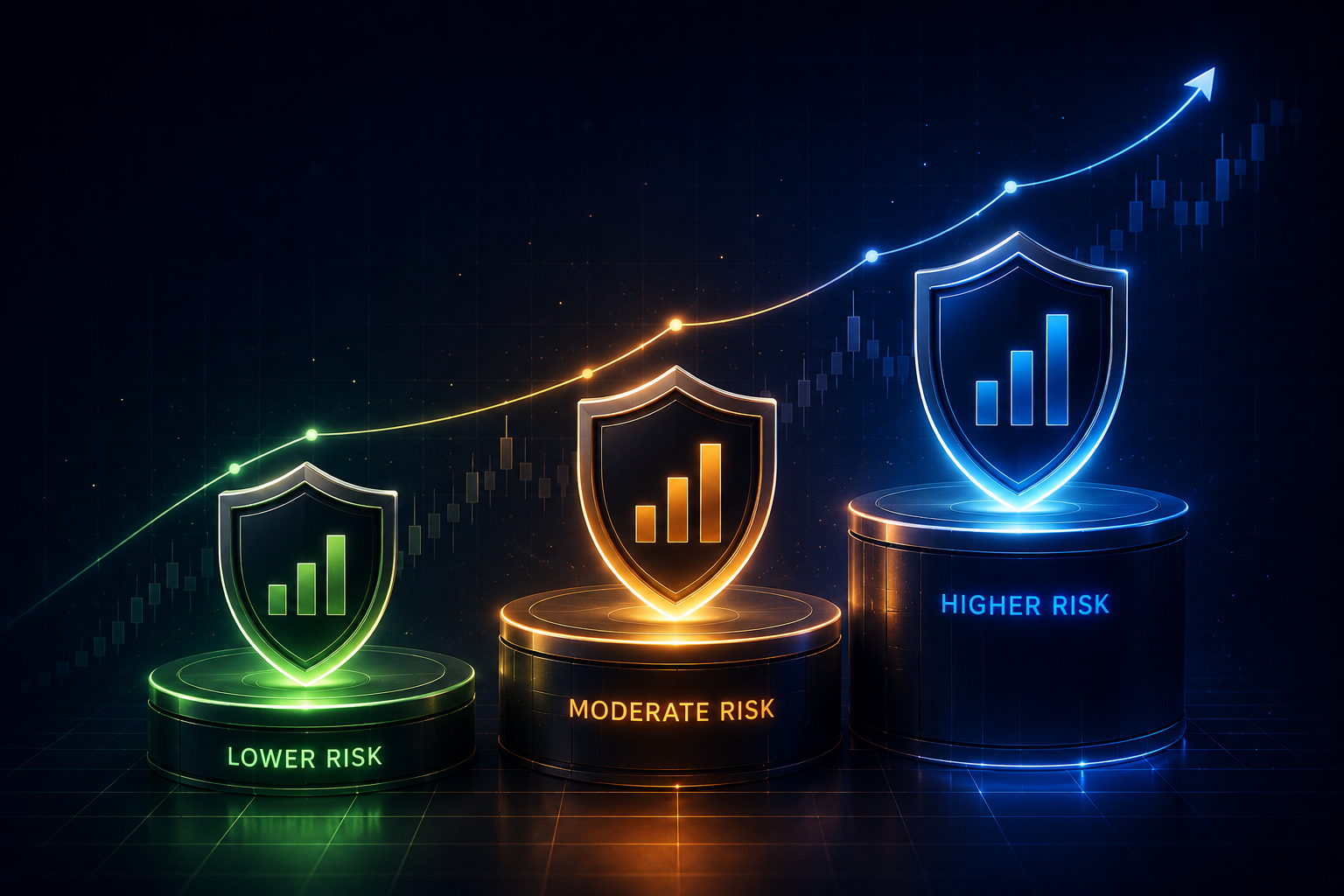
At AI Portfolios, we organize this into three clear risk tiers: Conservative, Moderate, and Aggressive. Here’s what each one actually means, and the scenarios where each one earns its place.
Conservative: When protecting what you have matters most.
A conservative strategy puts capital preservation first. The goal isn’t to chase the biggest possible gains — it’s to keep your money steady and shield it from sharp drops. In practice, that means a heavier weighting toward bonds, a tilt toward stable, dividend-paying equities, and a smaller slice exposed to the swings of the broader market.
You give up some upside in exchange for a smoother ride. For the right situation, that’s exactly the trade you want.
When conservative is the right fit:
You’re approaching or already in retirement, and you need your savings to last rather than grow dramatically. A big market drop right before or during retirement is far harder to recover from, because you don’t have decades to wait it out.
You have a goal with a short time horizon: a home down payment, a wedding, tuition due in a year or two. Money you’ll need soon shouldn’t be exposed to the kind of volatility that could leave it short right when you need it.
You simply sleep better knowing your balance won’t lurch around. There’s nothing wrong with prioritizing peace of mind. The best strategy is one you can actually stick with.
Moderate: When you want growth and stability.
A moderate strategy is the balanced middle, built to grow your wealth meaningfully while cushioning against the worst of the swings. It blends a diversified mix of equities and bonds, typically anchored by a core of broad index funds, so you participate in market growth without putting everything on the line.
This is the tier many investors land on, and for good reason: it’s designed for the long, steady work of building wealth without the white-knuckle moments of an all-in approach.
When moderate is the right fit:
You have a medium-to-long time horizon, a decade or more until you’ll need the money, and you want real growth without betting the whole portfolio on it. You’re building toward a major goal like retirement that’s still years away, but you’d rather not stomach the full force of market downturns along the way.
You’re somewhere in the middle of your career, with income to keep investing but also responsibilities like a mortgage, a family, and other obligations that make stability matter as much as growth.
You want a portfolio you can largely set and let work, knowing it’s diversified enough to weather rough patches and still move you forward.
Aggressive: When time is on your side.
An aggressive strategy is built for maximum growth. It leans heavily into equities, with more concentration in growth-oriented sectors and a higher tolerance for short-term volatility. The bet is straightforward: over long stretches, taking on more risk has historically been rewarded with more growth, but the path is bumpier, and down years can be steep.
This tier isn’t about recklessness. It’s about having the time and the temperament to ride out volatility in pursuit of bigger long-term gains.
When aggressive is the right fit:
You have a long time horizon, often decades, before you’ll touch this money. Time is the single biggest factor that makes higher risk reasonable, because it gives your portfolio room to recover from downturns and compound through them.
You’re early in your career or your investing journey, with years of future income ahead and a small balance that has lots of room to grow. You’re investing money you genuinely won’t need for a long time, and a temporary 20% or 30% drop wouldn’t force you to sell or derail your life.
You can stay calm when markets fall. This is the quiet requirement that matters most. An aggressive strategy only works if you don’t abandon it at the bottom; the moment that turns a paper dip into a permanent loss.
Why your risk tier isn’t set in stone.
Here’s the part that’s easy to miss: the right tier for you today may not be the right tier in five years. Life moves, and your strategy should move with it.
A new job, a growing family, a major purchase on the horizon, a shift from building wealth to drawing on it; each of these can change how much risk makes sense. That’s why AI Portfolios treats your risk tier as a living part of your plan, not a one-time checkbox. When your situation changes, your strategy can be re-evaluated, so the way your money is invested keeps reflecting the life you’re actually living.
And you’re never guessing in the dark. The platform helps translate your goals, time horizon, and comfort with risk into a clear strategy, then explains in plain language why your portfolio looks the way it does. The aim isn’t to push you toward more risk or less. It’s to land you in the tier that fits your real situation, with a clear-eyed view of the trade-offs either way.
The right risk is personal.
There’s no universally “best” risk tier, only the one that fits your goals, your timeline, and what lets you stay invested through the inevitable ups and downs. Conservative protects. Aggressive reaches. Moderate balances the two. The skill is matching the tier to the moment.
That’s the whole point of having a strategy built around you: not a one-size-fits-all portfolio, but an intelligent match between how your money is invested and the life you’re building with it.
If you’re ready to find the best investment strategy for your goals, we’re here to help. Learn more about how AI Portfolios works or request access to be the first one on the platform when we go live.